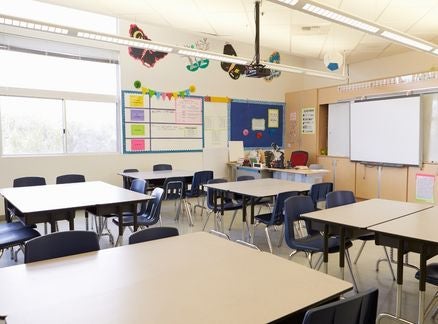
Every fall, schools open their doors with empty seats in the staff lounge. A new hire is settling into a room where someone else's name tags are still taped to the cubbies. It happens so often that it's easy to treat as background noise.
What turnover costs
According to the Learning Policy Institute's 2024 update on teacher turnover, replacing a single teacher costs schools somewhere between roughly $11,860 and $24,930, depending on district size, covering separation, recruiting, hiring, and training a replacement. Nearly 1 in 7 public school teachers moved schools or left the profession entirely between the 2020–21 and 2021–22 school years, and about three-quarters of that turnover was voluntary, not retirement.
Run the math across a mid-sized district losing even a few dozen teachers a year, and the number stops looking like a line item and starts looking like a missed opportunity such as money that could have gone toward mentoring, coaching, or classroom resources instead of onboarding someone new for the third time in five years.
Why teachers are leaving
Ask teachers directly, and a clear pattern shows up: classroom behavior is one of the biggest drivers of attrition (not the only one, yet a consistently large one).
- A 2022 survey of 615 Midwestern K-12 teachers by Chalkboard Review found that 51% cited student behavior as their primary reason for leaving, more than salary, safety concerns, and political friction combined.
- In a 2026 nationally representative EdWeek Research Center survey of more than 5,800 teachers, 35% said student behavior had gotten "a lot worse" compared to the year before.
- A University of Missouri study of teachers post-pandemic found 78% had thought about leaving the profession altogether, citing a mix of workload, compensation, administrative support, and difficult student behavior.
- In Boys Town’s own independent market review, we found similar results
Researchers studying this pattern have also found it hits hardest where preparation is thinnest: teachers who report significant behavior problems at their school are more likely to leave, and novice teachers (who typically receive the least classroom management training before stepping into a room of 25 kids) are especially likely to leave early in their careers.
That's a preparation gap and preparation gaps are fixable.
The retention math schools can act on
Here's the more hopeful half of the Learning Policy Institute's data: turnover isn't just a fact of life to absorb. It responds to conditions schools can change.
Teachers who report strong, effective school leadership and support stay at roughly half the rate of turnover as teachers who don't (9.0% versus 18.7%). Teachers with high job and workplace satisfaction leave at less than half the rate of teachers with low satisfaction, 8.0% versus 22.0%. Behavior and classroom-management support are a meaningful part of what builds that satisfaction, because a teacher who feels equipped to handle what's in front of them each day is a teacher who's more likely to still be there next August.
What moves the needle
The results are consistent. In one study of a manualized classroom management program layered onto schools already using schoolwide positive behavior support, researchers found significant improvements in how consistently teachers used core practices like praise, and in how well classroom systems functioned overall (Oliver, Lambert, & Mason, 2019). In a multi-year study of 56 teachers in an urban school district, higher fidelity to the classroom management program was linked to greater student engagement and fewer suspensions (Burke et al., 2011). A separate implementation in Hartford, CT elementary schools found the same thing: teachers who used the program with high fidelity had more students on task and fewer suspensions than those who used it lightly (Burke et al., 2007).
Bailey Elementary in Nevada improved its praise-to-correction ratio to 6:1 and reported greater staff consistency and confidence after adopting the Boys Town Education Model. West Gate Elementary in Palm Beach County saw disciplinary referrals drop 32% and absenteeism drop 15% year over year, alongside a 58% increase in parental involvement. Bellevue Public Schools, implementing the model across all 20 of its schools, reported educators feeling more confident managing classroom behavior and a more positive, consistent school climate district-wide.
Practice, not just training
The research points to a specific gap: teachers, especially new ones, aren't short on knowledge about classroom management. They're short on practice. A single day of PD can explain de-escalation or effective praise; it can't build the muscle memory for using it when a student is yelling and the clock is ticking.
Low-stakes, repeatable practice, with feedback attached, gives teachers the rehearsal time that a single workshop never can, and it's exactly the gap that shows up over and over in the research on why teachers leave and what helps them stay. Reality Coach is a great place to start!
The bottom line
Teacher turnover isn't an inevitability districts have to budget around forever. It's a cost driven substantially by classroom conditions and classroom conditions respond to real, sustained investment in teacher skill-building. The schools seeing the biggest gains aren't the ones that did one big training day but the ones that treated behavior support as an ongoing system, not a one-time event.
That's a better way to think about the budget line, too: not "what do we spend on PD," but "what does it cost us not to."
Sources: Learning Policy Institute (2024, 2026); Chalkboard Review (2022, via District Administration); EdWeek Research Center, The State of Teaching Project (2026); University of Missouri College of Education & Human Development (2025); Boys Town Applied Research Bibliography (Oliver, Lambert, & Mason, 2019; Burke et al., 2011; Burke et al., 2007; Burke, Guck, Robinson, Powell, & O'Neill Fichtner, 2006); Bailey Elementary School (NV) and West Gate Elementary School (FL) program data; Bellevue Public Schools implementation whitepaper.